
In today’s competitive market, packaging is crucial in ensuring products stand out while meeting consumer demand for sustainability and durability.
Enter In-Mold Labelling (IML), a technology merging labels with products during manufacturing, creating seamless, durable, and recyclable packaging. From yogurt cups to automotive components, IML is reshaping industries. This guide unpacks the technology, process, and its far-reaching impact.
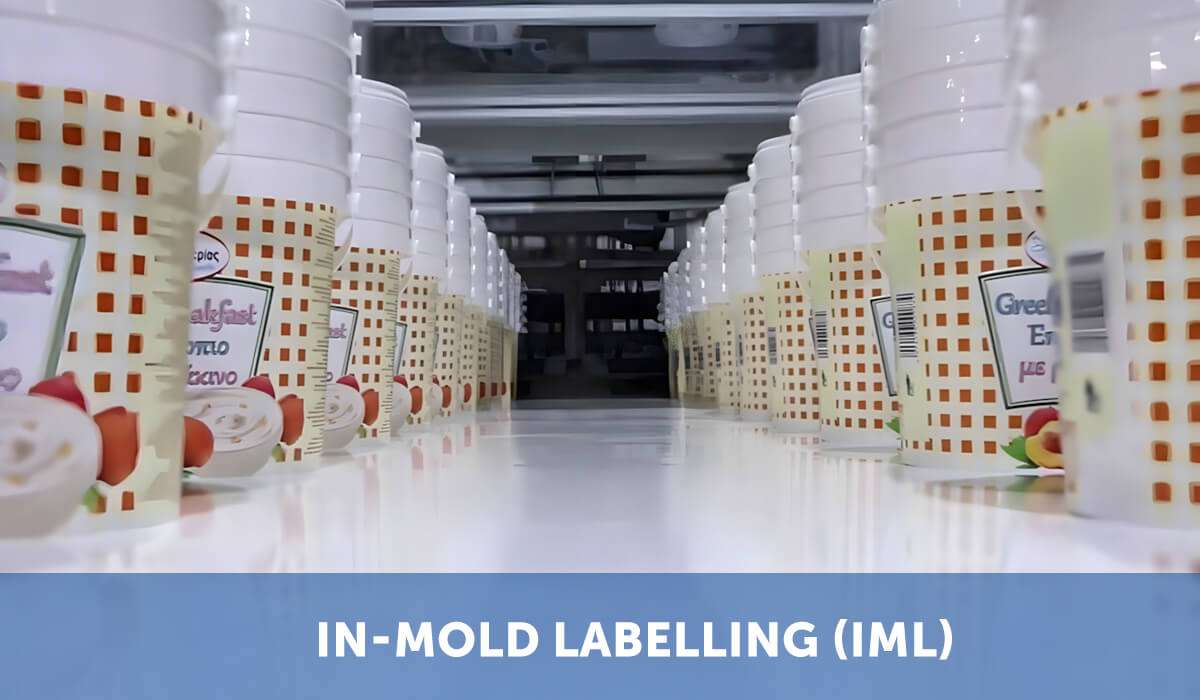
What is In-Mold Labelling (IML)?
In-mold labelling, or IML, is a special technique in which labels are fused with plastic containers during the manufacturing process, resulting in a seamless and durable product. Unlike traditional labelling methods, where stickers or glue-applied labels are added to finished containers, IML integrates the label during molding, ensuring it becomes an intrinsic part of the final product.
Key Characteristics
- Materials: PP (polypropylene) films dominate for recyclability.
- Integration: Labels bond permanently, resisting peeling or fading.
- Versatility: Works with injection molding (rigid containers), blow molding (bottles), and thermoforming (trays).
How IML Differs from Traditional Labeling
- Traditional Labels: Applied post-production using adhesives or pressure-sensitive techniques.
- IML Labels: Integrated during the molding phase via injection, blow, or thermoforming, resulting in a unified product with no risk of peeling or damage.
| Aspect | IML | Adhesive Labels |
| Durability | Resists water, abrasion, and UV | Prone to peeling, fading |
| Production Speed | 10,000+ units/hour | Slower due to post-molding steps |
| Waste | Minimal (no glue/backing paper) | Higher (linear waste, adhesive) |
IML VS traditional labeling table
The IML Process
The IML process involves embedding polypropylene labels directly into the plastic product during its formation. This ensures the label is permanently bound to the container’s surface.

Step 1: Label Production
IML starts with printing high-quality polypropylene labels using advanced techniques such as gravure or digital printing. These labels are specially designed to withstand the heat and pressure of the molding process without losing their texture or color.
Step 2: Label Placement
Before the molding process begins, robotic arms or automated systems precisely position the label into the mould cavity. Accurate positioning ensures seamless integration with the plastic material.
Step 3: Moulding
During injection, blow, or thermoforming, molten plastic is introduced into the mould. The heat and pressure cause the label to fuse perfectly with the container’s surface, creating a single, unified product.
Step 4: Finished Product
Once the product cools down and solidifies, the label is permanently bonded to the container. The result is a high-quality, tamper-proof, visually appealing product ready for use.
Technologies Used in IML
IML typically uses injection molding, blow molding, or thermoforming. Each method is chosen based on the product’s design and material requirements.
Benefits of In-Mold Labelling
IML offers numerous advantages over traditional labels, making it an excellent choice for manufacturers seeking quality and efficiency.
Durability
IML labels become an integral part of the container, offering resilience against scratches, moisture, and wear and tear. They are ideal for challenging environments, from freezing to humid storage areas, and they can withstand freezer-to-microwave cycles (common in food packaging).
Enhanced Aesthetics
IML labels offer high-resolution printing capabilities, allowing for vibrant colors and detailed graphics without edge curling or glue residue.
Glossy and matte finishes, as well as 3D textures, are achievable. This results in visually appealing packaging that enhances brand recognition and customer appeal.
Cost and Speed Efficiency
Since labelling is integrated during manufacturing, IML eliminates secondary processes such as adhesive application and manual placement. This streamlines production, reducing costs and turnaround time.
Example: Unilever cut packaging costs by 18%, switching to IML for shampoo bottles.
Environmental Sustainability
IML uses polypropylene labels made from the same material as the plastic containers they adhere to(PP labels + PP containers = monomaterial). This homogeneity makes the product fully recyclable, meeting growing consumer demand for eco-friendly packaging.
Tamper Resistance
Labels attached during molding are nearly impossible to remove or manipulate, ensuring enhanced security for packaged goods, especially in industries such as pharmaceuticals and food.
Applications of In-Mold Labelling
IML’s versatility allows it to be used across diverse industries, enhancing packaging quality and branding.

Food and Beverage Packaging
IML is widely used in food-grade containers such as yogurt tubs, ice cream buckets, margarine containers, and disposable cups. Its durability and tamper-proof design make it ideal for preserving sensitive food products.
Consumer Goods
IML is commonly used on shampoo bottles, fertilizer containers, detergent packaging, and other consumer products that require robust and aesthetically pleasing packaging.
Industrial Products
Heavy-duty containers, such as paint buckets, lubricant cans, and chemical packaging, benefit from IML’s durability and scratch resistance.
Medical and Pharmaceutical Packaging
In the pharmaceutical industry, IML ensures secure packaging with clear, vibrant labels that meet stringent quality standards.
Challenges With IML Technology
Despite its many benefits, IML does come with certain challenges:
- Initial Investment Costs: The initial setup of IML equipment and moulds can be expensive, though long-term savings offset this over time.
- Complexity in Design: Labels and moulds must be designed to precise specifications, requiring skilled professionals and advanced technology.
- Limited Small-Scale Viability: IML is more cost-effective for large-scale production, making it less accessible to smaller manufacturers.
Partner with GO4mould for your in-mold labelling needs
As a professional mould manufacturer, GO4mould offers a comprehensive one-stop in-mold label injection molding service tailored to your needs.
From precise mould design and advanced production technology, to efficient production and after-sales support, GO4mould is your trusted partner for seamless IML solutions that combine durability, aesthetics, and sustainability.
Contact GO4mould today, and let us help you transform your packaging into a powerful marketing tool.

Conclusion
In-Mold Labelling isn’t just a packaging upgrade—it’s a strategic shift toward efficiency, durability, and sustainability. As brands face pressure to meet ESG goals, IML offers a tangible solution. Whether you’re a startup or a multinational, exploring IML could redefine your product’s lifecycle.
